


There's a moment in every founder's story when the problem becomes unavoidable.
Mine came in 2019, staring at a spreadsheet that would make most people weep.
My team at Amazon had analyzed my calendar for the previous quarter. The verdict: I was spending 73% of my time on work that wasn't aligned with my actual priorities.
The person delivering this news? My executive assistant from the CFO's office—a professional so senior she probably didn't need to work for me at all.
She'd downloaded three months of calendar data, categorized every meeting by strategic value, cross-referenced my stated annual goals (OP1, in Amazon-speak), and produced what I can only describe as a performance review for my attention.
It was humbling. It was also the most valuable conversation of my career.
The EA I Didn't Know I Needed
Before her, I'd had two other EAs.
The first was basically a human calendar API—I provided every detail, making it feel like more work than doing it myself. Status symbol, not asset.
The second was better. I even read a book on how to be an EA to become a better manager. She could filter requests, prioritize interruptions, keep me roughly on track.
But the third EA? A different species entirely.
She didn't just manage my calendar—she managed my attention, the scarcest resource in complex work.
When someone requested a 1:1, she didn't simply find a time. She evaluated whether that topic deserved time this week against everything else competing for those neurons.
She helped me see that I had time for the meeting, just not for that discussion—at least not yet.
The insight: Amazon wasn't getting the most hours from me; it was getting the most value.
I've never been more effective.
And I couldn't stop thinking: How much better would the last decade have gone with this superpower from day one?
The Spreadsheet That Launched a Company
Fast-forward to 2024.
I'd left Amazon, scaled supply-chain tech at StockX, and most recently led global onboarding compliance at Stripe—one of the most technically complex projects in the company's history.
At Stripe, I built an LLM-based policy evaluation engine that replaced hundreds of brittle keyword rules. It cut manual reviews by 82% and made high-stakes compliance decisions in under 24 hours. Multi-stage reasoning. Explainable outputs. Cited sources. Not a black box.
But here's what stuck with me: I looked around at some of the smartest people I've ever worked with, and they were drowning.
Brilliant minds, overwhelmed by the sheer volume, density, and pace of information attacking their attention every day.
Most needed the kind of EA support I'd been lucky enough to have at Amazon—the kind that changes how you work.
But that support? Reserved for a tiny fraction of executives, often several promotions away. And even when they got it, many underused it—reducing world-class leverage to glorified calendaring.
The Comic That Broke Me
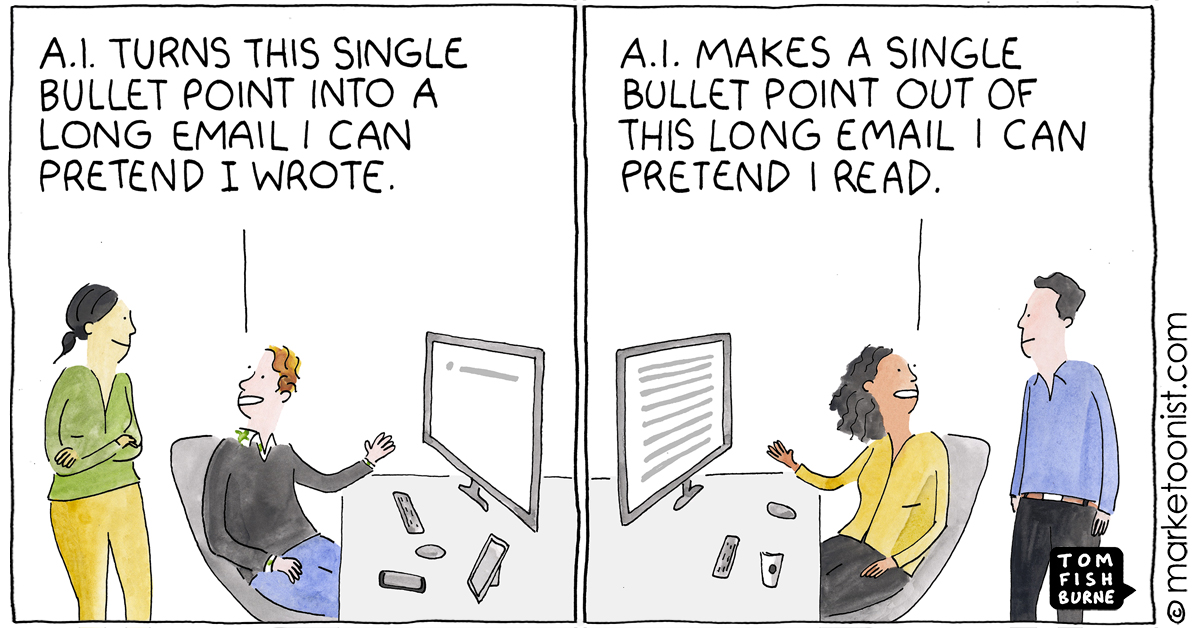
Via Marketoonist
Two panels. Left: "AI turns this single bullet point into a long email I can pretend I wrote." Right: "AI turns this long email into a single bullet point I can pretend I read."
I laughed. Then I realized: we're at an inflection point. AI will either solve this problem—or make it catastrophically worse.
Soon, every inbox will fill with perfectly written noise.
Tools that turn "yes" into three paragraphs of filler. And on the receiving end? Tools that must turn those paragraphs back into "yes."
But most "AI inbox" startups are building the wrong side of the equation.
They're chasing Inbox Zero. They're building features. They're optimizing workflows. What they're not building is what made that CFO's EA transformative: deeply personal, contextually aware, behaviorally adaptive attention management.
What an EA Actually Does
(That AI Finally Can)
The uncomfortable truth: You can't manage attention with settings screens and checkboxes.
A world-class EA doesn't ask you to define "important." They observe.
They spot the patterns you can't see and gently call you out when your behavior diverges from your goals.
They learn that your boss's emails are urgent—except Thursday afternoons, when she's just thinking out loud. They notice recruiter messages eat 40% of your response time even though you said you wanted to focus on product. They know you're most responsive to customer escalations in the morning and let them pile up later.
And when your behavior drifts? They ask: "Still the priority?"
That's not configuration. That's learning.
For a decade, that required a human—someone with context, judgment, and intuition. But in 2025, for the first time, we can build it.
LLMs that reason
About nuance and context at human-EA levels
Behavioral learning
From actions, not surveys
Unlimited context
Near-infinite memory for every user
Technical Deep Dive: For the complete technical implementation of our behavioral drift detection and conversational recalibration system, see our published research paper.
The gap between "spam filter" and "world-class EA" isn't incremental—it's architectural.
Why This, Why Now, Why Me
I've lived the pain.
I've been the executive checking email at 11 p.m., missing critical items, wondering if I'd ever dig out.
I've seen the solution.
I've felt what truly great EA support can do—and I've watched brilliant people suffer without it.
I have the technical chops to build it.
At Amazon, my team deployed ML at scale—taking product safety from manual review to predictive models across 40M+ weekly interactions. We presented to the Board. I'm a named inventor on US Patent 10,223,353 behind Amazon's Choice.
At Stripe, I built LLM-powered compliance systems that made explainable, high-stakes decisions at global scale.
And now, for the first time, the tools, models, and economics all line up.
What I'm Not Building
Another Inbox Zero app
I don't care if you hit zero. I care if you missed something that mattered.
Generic AI sorting
"Urgent" depends on your context—project, season, even life stage.
Another notification system
We don't need more pings. We need smarter ones.
A passive tool
You shouldn't open an app; it should brief you and let you reply by text.
What I Am Building
Precedent is the EA I wish I'd had at 30 instead of 40.
It monitors your email 24/7, learns your unique definition of "urgent," delivers concise briefings via SMS or Slack, and gently coaches you toward your goals.
It learns that your spouse's texts matter more than investor updates—unless you're fundraising. It detects that recruiter emails are eating your time and asks if that's still the plan.
And it gets smarter the longer you use it—no settings required.
The North Star
What would you pay for a product that gave you back 15 hours a month and ensured you never missed something important?
For someone billing $300/hour, the math is obvious. But the real value isn't financial.
Waking up to a 30-second briefing with the three things that matter today—and the confidence to ignore the rest.
Never feeling that stomach-drop of realizing you missed a critical email.
Going from checking email 20 times a day (anxiety) to three (calm confidence).
Feeling in control of your attention again.
Why It Matters Beyond My Inbox
Attention compounds.
If 1,000 executives reclaim 15 hours a month, that's 180,000 hours a year redirected from inbox triage to high-leverage work.
That's companies funded, products shipped, strategies pivoted.
And the timing matters. The same LLMs that summarize email can generate it—at near-zero cost. The future splits two ways:
Dystopia
AI noise versus AI filters, drowning signal in spam.
Utopia
Intelligent systems that learn what matters and guard your focus.
I'm building for the second future. Because the first one is terrifying.
The Uncomfortable Part
Building Precedent means asking people to trust AI with their most sensitive data: their email.
I get it. I've spent my career in compliance and safety. Here's my commitment:
21-day retention: Emails auto-delete after three weeks. Enforced in code, auditable in logs.
Exclude rules: You decide what AI never sees—by sender, keyword, or domain.
Privacy-first architecture: Row-level security, encryption at rest, zero data sharing.
Explainable decisions: Every urgency score comes with reasoning and citations.
I'm not asking for blind trust—only that you trust someone who's spent 15 years scaling safety systems to do this responsibly.
What Success Looks Like
Three months after launch, I want users saying:
"I can't imagine going back."
Not "it's useful." Not "I'll keep trying it."
"I can't imagine going back."
Because that's how I felt about my EA from the CFO's office—and that's the bar.
If I build this right, Precedent becomes the first tool you set up in a new job. The one subscription you'd pay for yourself. The product you recommend to your boss before they ask. Not because it's impressive. Because it's essential.
The Part Where I Admit This Might Fail
This is hard.
Building truly personalized AI—the kind that learns and evolves—isn't prompt engineering. It's architecture. Behavioral science. Trust.
The gap between "AI that summarizes email" and "AI that manages attention" is vast. Even if we solve the tech, there's a go-to-market gap: convincing people to value a thing they've never experienced.
So yes, this might fail.
But you know what definitely fails? Not trying.
Why I'm Sharing This
Most founders write reflective essays after their Series B, when they can afford to sound philosophical.
I'm writing this now—at the beginning—because I want to be held accountable.
Precedent isn't a lifestyle business, a feature waiting to be acquired, or a stepping stone.
It's the product I wish existed fifteen years ago. The one I'd pay $500/month for without blinking.
And if I can extend even a fraction of that EA-from-the-CFO's-office magic to people who'll never get it otherwise? That feels more impactful than self-driving cars.
If this resonates, I'd love to hear from you.
Email the founderRequest an invitation — early users get lifetime founder pricing ($299/month)
— Chance
P.S. To my former EA from the Amazon CFO's office: thank you. You changed my career. This is my attempt to pay it forward.
Precedent is in private beta. Currently supports Gmail. All email data deleted after 21 days. Building toward SOC 2 Type II (planned 2026).